Rivetation Records
Imaginary Line
Imaginary Line
Verfügbarkeit für Abholungen konnte nicht geladen werden
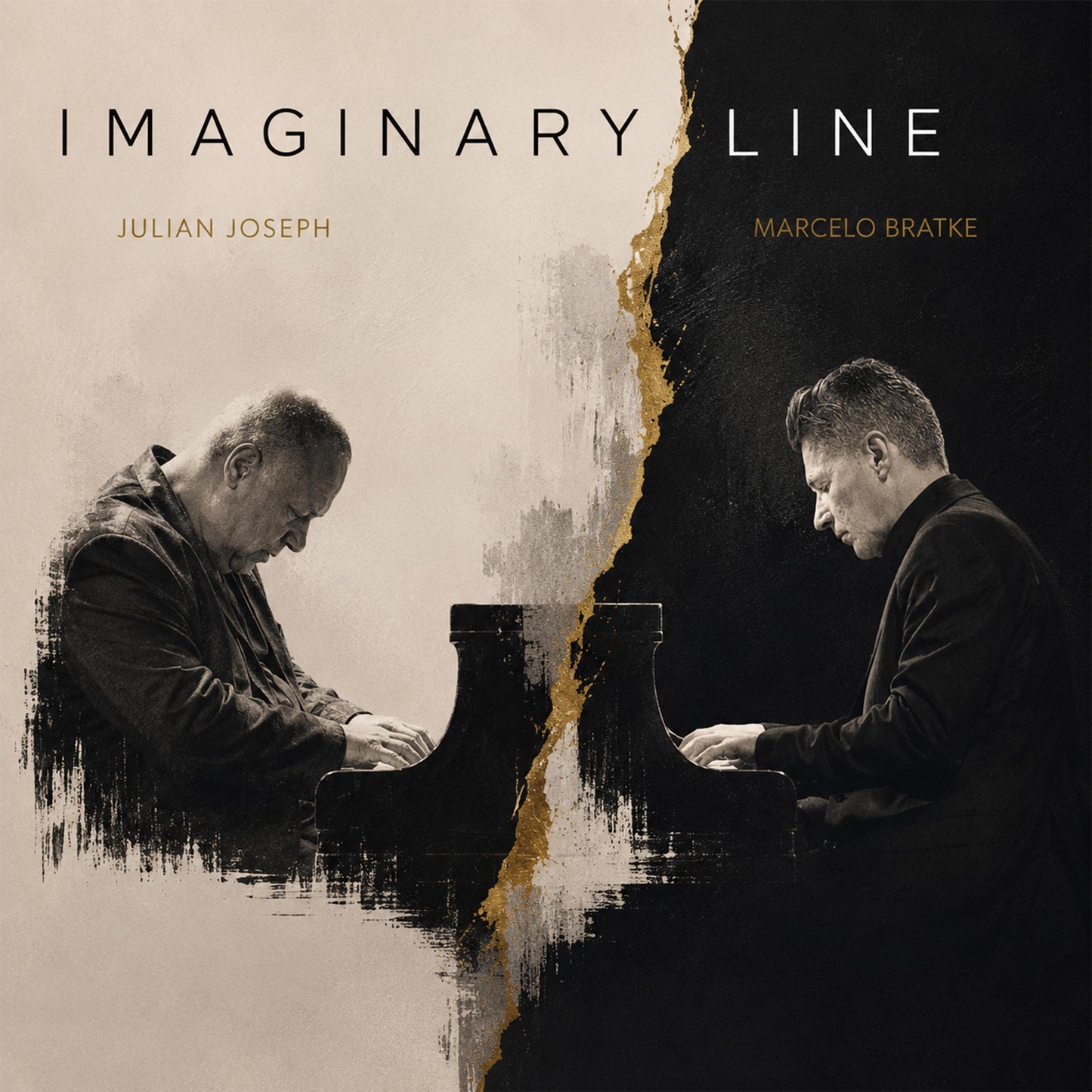
Jazz FM Interview (11am 27th May) TX 30th May. RadioKerry (Ireland) TX 14th May BBC Radio 3 Record Review 23rd May This Album presents four jazz composers (the classics of jazz) and four 20Th Century classical composers (whose music contains a strong element of jazz) in a new and contemporary dialogue. From Thelonius Monk to Igor Stravinsky, pianists Julian Joseph and Marcelo Bratke initiate a series of imaginative exchanges between the pre-established structures of classical music and the improvisation of jazz. The 'imaginary line' is the line that divides these two apparently antagonistic worlds, but which in this case becomes a line of communication, bringing the worlds of jazz and classical closer together and allowing us to see the music as a unit. In duet if one can achieve expression on any true level through creative synergy then the collaboration can exist. The Imaginary Line speaks to remind us of the oneness of music and seeks to remove the boundaries created over time either as a need to hold on to tradition or as a reflection of an inability to change or adapt. Marcelo has very bravely taken on the challenge of Jazz with its many unique requirements and has put his trust in me to direct his vast training and considerable musical talent to create the feeling of Jazz. I also have put my faith in him for the Classical side of this project which was born out of a mutual admiration between the two of us and early discussions about doing a Gershwin recording. It was an obvious choice - the music of Gershwin - because I had performed all the various piano and orchestra works and it is often the most chosen path for collaboration between Jazz and Classical disciplines. But the philosophies engendered by true exposure to both musics left the prospect of a much bigger statement and the question: can we communicate within each other's respective disciplines? Marcelo already had the idea and most of the repertoire before approaching me about fleshing it out and to consult on the appropriate material, so we discussed and changed various pieces and set about pulling the concept into the realms of reality. The result is a realisation of the principles of 'The Imaginary Line' finding parallels between composers from each idiom and unifying them in a statement about 20th Century music and its commonality by revealing the expansive quality of our musical choices and how that limitless influence spreads beyond neat categorisation. Gershwin's 'Preludes' draw their influence quite blatantly from jazz and we parallel that with the hypnotic elegy of Duke Ellington's 'Single petal of a rose' the comparison of these two giants and contemporaries is overwhelmingly obvious.Milhaud's 'Scaramouche' is strong in its Latin/Brazilian flair with great balance between piano's which is reflected in the approach to Chick Corea's 'Armondo's rhumba'.Poulenc's 'Sonata for two pianos' with its strong identifiable impressionist feeling coupled with an intoxicating groove mirrors the captivating Bill Evans classic 'Waltz for Debby'.Stravinsky's 'Pieces for two pianos' display rhythmic and harmonic complexity within simplicity and an excitable energy and danger, qualities that are hallmarks of Thelonious Monk's 'Off minor'. In seeking to remove the divide and challenge the pre-eminence of categorisation we have come closer to accepting that music-making in both disciplines come from the same spiritual source. Our aim is to bring to life music beyond the realm of confined expectation that exists as its own entity free from divisions and open to connection through dialogue. Tracklisting George Gershwin - Three Preludes for Two Pianos 1. Prelude 1 2. Prelude 2 3. Prelude 3 Darius Milhaud - Scaramouche for Two Pianos 4. Vif 5. Modere 6. Braziliare Frances Poulenc - Sonata for Two Pianos