Bureau B
Adonia
Adonia
Impossible de charger la disponibilité du service de retrait
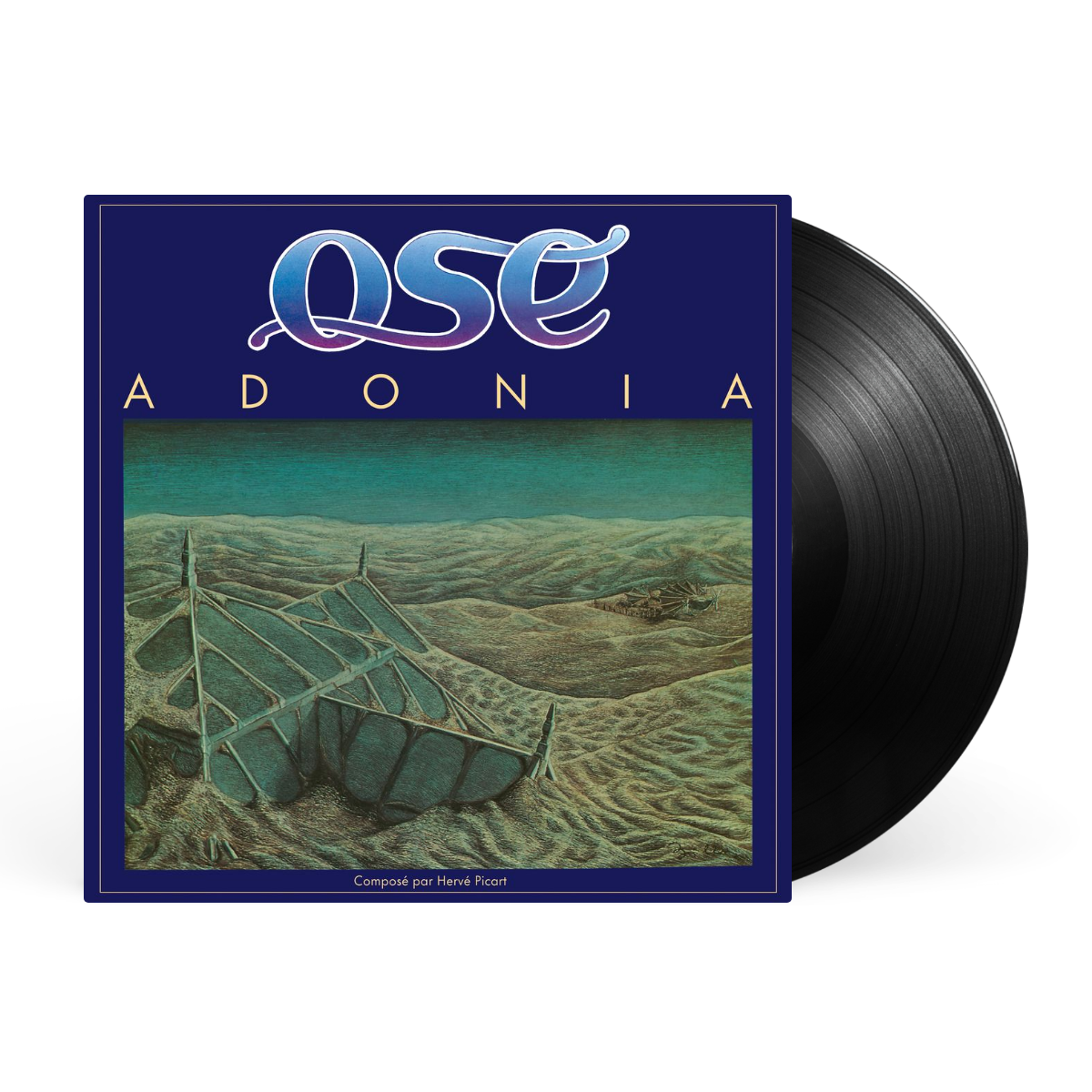
Recorded in June 1978 during a sweltering Paris summer, Ose’s Adonia captures a rare alignment of intellect, imagination and emerging technology. At just 26, Hervé Picart was living three parallel lives: scholar of rhetoric and ancient languages, journalist for the French music press (notably Best), and guitarist /bassist in progressive garage bands. Drawn increasingly away from British prog toward keyboards and synthesizers, he began envisioning a more spatial music situated somewhere between Pink Floyd, Tangerine Dream and Kraftwerk. That triangulation would define Adonia. Ose itself was conceived as a variable-geometry project devoted to concept albums, with narrative and composition as guiding forces. Picart imagined a platform that could accommodate shifting collaborators and literary or interplanetary themes.
For Adonia, the collaboration formed close to home. Through his journalism he had befriended Richard Pinhas of Heldon, a fellow academic and near neighbour in Paris’ Latin Quarter. Their shared philosophical and musical affinities created a natural bond. Picart invited Pinhas not simply as a guest but as a key creative partner, overseeing electronic arrangements and contributing guitar and synthesizer work. Heldon drummer François Auger completed the trio, valued for his remarkable ability to play tightly against sequencers without losing fluidity. Arriving with detailed demo tapes, Picart had mapped much of the material in advance, yet the studio remained a site of invention. Sessions took place at night in Barclay’s large studio on Avenue Hoche, by day home to a grand orchestra, prompting moments of astonishment when classical musicians encountered the trio’s imposing array of synthesizers, including the Moog 55 modular system. Recorded in a week and mixed in three days: a focused, pre-digital intensity emblematic of the era. Conceptually, Adonia fuses ancient myth and speculative fiction. Its title references Adonis, figure of renewal and desire. The planet Adonia, imagined as Herbert’s Dune refracted through the lens of hallucinatory French illustrator Philippe Druillet, becomes a terrain where sensuality and the mechanical intertwine, a dialogue between the organic and the electronic that animates the entire album. "Approche Sur A” charts a slow descent to the surface, panning drones and chiming electronics dissolving into cavernous tape delay as low-end currents rise and echoing guitars trace the contours of a shimmering horizon. When syncopated hats and a swinging bassline finally engage, the journey turns kinetic, heat rippling across an endless expanse of sand. "Orgasmachine” ventures deeper into Adonia’s inner workings, staging a charged collision between slide guitar’s sensual bend and sequencer precision; a rising progression and urgent, double-tracked guitars build toward a bold electronic solo before the piece combusts in a blaze of laser fire. Night falls with "29h 08mn”, Eastern-tinged scales drifting over a humid chug as the Mini Moog swells into a sustained crescendo driven by formidable drums. "L’Aube Jumelle” greets twin suns in widening arcs of melody and scorched guitar light, while “Retour Sur Adonia” completes the cycle in celebratory form, pastoral warmth fused with gleaming circuitry, the voyage resolved in radiant equilibrium. Upon release on the French imprint Egg, Adonia was warmly received, pressed internationally and even adopted for radio and television themes abroad, including unlikely quiz-show use in Japan. No concerts followed; Picart favoured the precision of the studio over imperfect live renditions. Over time, the album attained cult status, its sonic freshness undimmed. Standing at the crossroads of Berlin School electronics, progressive rock and early synth-pop, Adonia refracts these currents through a distinctly French sensibility and Pinhas’ singular presence. Nearly half a century on, its fusion of myth and modernity remains vivid, a testament to a fertile moment whose echoes continue to resonate.